
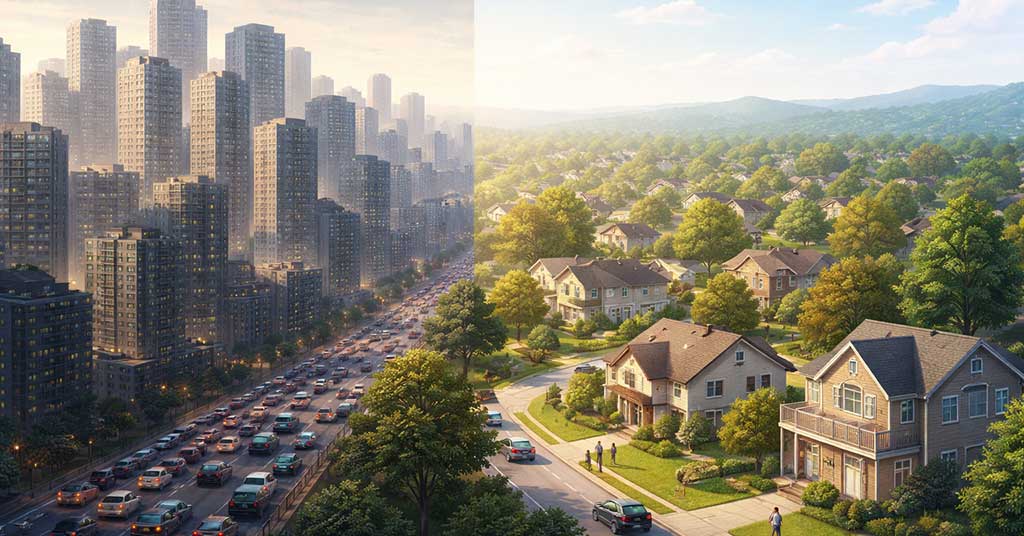
The road to national renewal now runs through the countryside
Key points
- Life in Canada’s big cities is getting harder, with housing costs climbing fast and families feeling the financial pinch.
- Many office jobs are less secure as AI spreads, but hands-on trades that build homes, energy projects and industry are in growing demand.
- Both of those reasons are leading more Canadians to move to smaller communities.
- And that shift to rural life could reshape the country’s economic future.
What’s this?
 What began as crisis has become opportunity. A Rural Renaissance is reshaping where Canadians live, how they work and how Canada rebuilds the industrial and human foundations of national resilience.
Canada did not choose this moment of transformation, but it cannot afford to ignore what it has revealed. The pandemic, the housing collapse and AI disruption exposed just how fragile Canada’s urban-centric, import-dependent, service-based economies have become. They forced a reckoning with where and how this country can remain productive, secure and sovereign.
The Wuhan outbreak was more than a public health emergency. It was a geopolitical awakening. When the virus escaped Wuhan under a shroud of censorship, and when the Chinese government suppressed early intelligence on SARS-CoV-2 while hoarding global PPE supplies, North Americans discovered how deeply decades of offshoring had hollowed out its industrial base.
Supply chains buckled. Pharmaceuticals, semiconductors and basic manufacturing inputs became chokepoints. The illusion that globalization guaranteed stability evaporated almost overnight.
For Canada, the lesson was stark. A nation that cannot produce essential goods is a nation that cannot protect its people. Economic sovereignty is national security.
The pandemic also triggered something few policymakers expected. It set off one of the largest internal migration shifts in modern Canadian history. Between 2019 and 2023, Canada’s major metropolitan areas (Toronto, Vancouver, Montréal, Calgary and Edmonton) lost nearly 274,000 residents to smaller cities, towns and rural regions, according to Statistics Canada migration estimates.
This was not a trickle. It was a 350-fold increase over the negligible outflows of the previous decade.
Lockdowns pushed millions into remote work. Housing affordability, already strained, collapsed into crisis. In Toronto and Vancouver, detached homes soared to more than seven times median household income.
Young Canadians, priced out and exhausted, looked elsewhere. And “elsewhere” meant rural Canada.
But this migration is not simply about lifestyle. It reflects a deeper structural rebalancing of the nation, one accelerated by the rise of generative AI.
For 40 years, Canada steered its youth toward white-collar careers, promising stability in offices, tech firms and professional services. Meanwhile, blue-collar trades, once the backbone of national productivity, were treated as relics of a bygone era.
AI has flipped that script.
The jobs that replaced trades are now among the most vulnerable to automation. Coding, legal drafting and financial analysis are tasks AI already performs at scale, faster, cheaper and with increasing sophistication.
By contrast, the trades are becoming the new frontier of economic resilience. Welding, pipefitting, heavy equipment operation, power engineering, construction and electrical work all demand dexterity, spatial judgment and real-world problem solving that AI cannot replicate.
These are also the skills Canada needs to rebuild domestic manufacturing, expand energy production and construct housing.
The future of Canadian sovereignty will not be written in boardrooms. It will be built by tradespeople.
That is why the Rural Renaissance matters.
Rural and mid-sized communities offer what major cities increasingly cannot. They provide affordable land, attainable housing, cleaner air and the space required for energy-intensive industries. They are where new factories, refineries and critical mineral processing facilities can be built without the cost and constraints of major cities.
They are also places where skilled trades can afford to raise families.
The benefits extend beyond economics. Lower-density living is increasingly recognized as a mental health asset. Research shows that chronic exposure to noise, congestion and crowding is linked to elevated cortisol levels and eroded cognitive function. Rural environments, by contrast, reduce stress, improve mood and strengthen attention.
Perhaps the most overlooked dividend is social capital. Rural communities cultivate interdependence. Families rediscover traditional skills, including gardening, animal husbandry, carpentry and mechanics, that reconnect them to land and community. Newcomers integrate more deeply, not as anonymous transplants, but as contributors to shared local life.
Canada’s future prosperity still depends on productivity. And productivity depends on skilled, mobile, grounded people who can build, repair and operate the physical systems that keep a country functioning.
AI may transform the digital economy, but it cannot pour concrete, weld pipe or maintain a power grid. It cannot mine nickel, harvest wheat or construct a home.
Only highly skilled people can do that. Increasingly, those people are choosing to live outside the major cities.
The Rural Renaissance is not a retreat from modernity. It is a response to reality.
It positions Canada to reindustrialize, diversify supply chains and strengthen food and energy security. It aligns with the pressures of geopolitics, the realities of AI and the aspirations of families seeking stability and purpose.
The pandemic exposed vulnerabilities. The affordability crisis forced a reckoning. AI is rewriting the labour market.
Together, these forces have opened a path toward renewal, one rooted in soil, space and sovereignty.
Canada now faces a choice. It can cling to an urban-centric model that no longer serves it, or it can embrace the dispersed, resilient and productive future already taking shape across its rural heartlands.
The opportunity is immense. And the road to national renewal runs through the countryside.
Joseph Fournier is a senior fellow at the Frontier Centre for Public Policy.
Explore more on Housing, Canadian economy, Artificial Intelligence, Trades, Rural Life, Urban Life
The views, opinions, and positions expressed by our columnists and contributors are solely their own and do not necessarily reflect those of our publication.
Troy Media empowers Canadian community news outlets by providing independent, insightful analysis and commentary. Our mission is to support local media in helping Canadians stay informed and engaged by delivering reliable content that strengthens community connections and deepens understanding across the country.

