
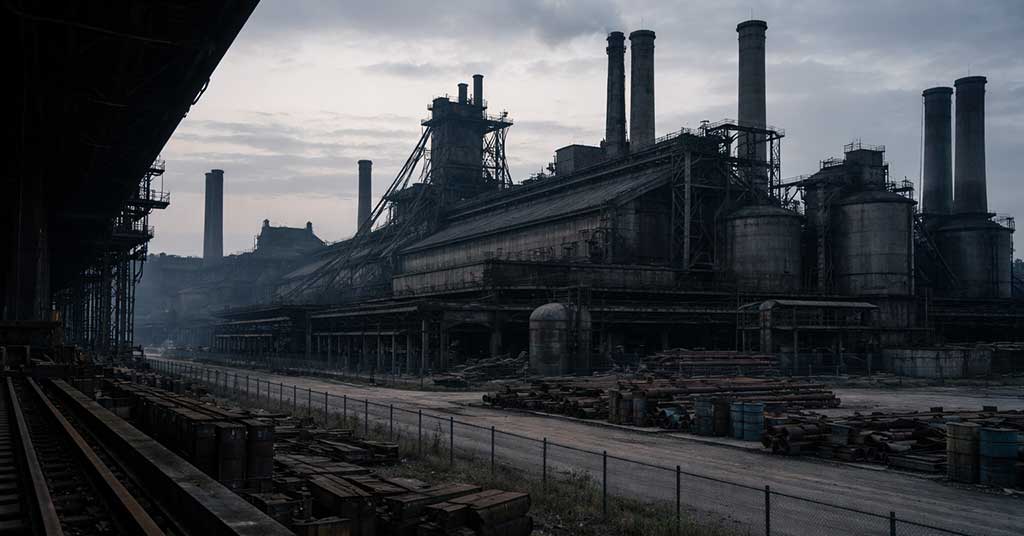
Higher industrial energy costs are driving up prices, cutting investment and weakening the very sectors Canada depends on for growth
Key takeaways
- Canada’s productivity is falling behind, which means slower wage growth and fewer opportunities for workers.
- The federal Industrial Carbon Tax raises energy costs for large industries, pushing their operating costs far above those of competitors in the United States.
- When factories, refineries and food processors pay much more for energy, those higher costs show up in prices, including at the grocery store.
- Higher costs also mean less investment, fewer expansions and fewer strong blue-collar jobs in the regions that depend on industrial work.
- If investment and production shift elsewhere, Canada’s economy weakens further, leaving households with fewer jobs, lower growth and less financial stability.
What’s this?
 Canada is facing a productivity crisis that can no longer be waved away as a statistical quirk or an academic concern. The Bank of Canada has warned repeatedly that our economic output per worker is falling behind our peers, and the consequences are already visible: stagnant wages, declining investment, and a shrinking capacity to compete in global markets.
Yet at the very moment when the country needs to unleash its most productive industries, the federal government continues to tax them more heavily than any other advanced economy.
The Industrial Carbon Tax, part of the federal carbon pricing system for large industrial facilities, is a direct tax on productivity itself.
Imagine a worker who generates five days’ worth of revenue for their employer while only working four. That is what high productivity looks like: more value created per hour, more prosperity per unit of effort.
Now imagine forcing that same worker to perform the same job while carrying a backpack full of rocks. They may still get the work done, but they will do it more slowly, at greater cost, and with less competitive edge.
This is precisely what Ottawa’s Industrial Carbon Tax is doing to Canada’s most productive sectors.
The Industrial Carbon Tax will ultimately add roughly $8 to $9 per gigajoule to natural gas, while the fuel itself costs only about $1.70 per gigajoule in Alberta.
The tax will drive the cost of that energy to four to five times its original price.
No industrial economy can thrive under a regime where the tax on energy dwarfs the cost of the energy itself. And no government that claims to care about productivity can justify a policy that forces factories, mills, refineries, and food processors to pay dramatically more for industrial heat than their competitors across the border.
This is not an abstract concern. It is already showing up in grocery bills. Canadians are bracing for what many economists warn will be a second wave of food inflation. The first wave was triggered by the global supply chain rupture during the 2020-22 COVID-19 lockdowns.
The second wave is being manufactured domestically as a result of federal policy.
A large industrial bakery or food processor in Alberta or Saskatchewan will have to pay far more to fire its ovens and dryers than a similar plant in the United States, where recent regulatory changes have removed federal climate policy constraints on industrial energy use.
When a Canadian plant pays significantly more for heat than a competitor in North Dakota, the outcome is inevitable: higher prices and a growing incentive to shift production south. That pressure extends beyond a single plant. This is the quiet part of the productivity crisis that few in Ottawa seem willing to acknowledge.
Canada’s highest productivity industries are also its most energy reliant.
Mining, refining, petrochemicals, steelmaking, fertilizer production, and advanced manufacturing all rely on large volumes of affordable, reliable energy. These sectors routinely generate labour productivity far above the national average and pay wages that support families, communities, and regional economies.
They are the backbone of the country’s export capacity and the anchor of its industrial base.
When the cost of energy rises by a factor of five, companies do not simply absorb the difference. They cut investment, delay expansion, automate more slowly, reduce hiring, offer smaller wage increases, or close facilities entirely.
A tax that was sold as a tool to reduce emissions has become a tool that reduces productivity, competitiveness, and national resilience.
The timing could not be worse.
Since 2020, Canadians have been leaving Toronto, Vancouver, and Montreal in record numbers and moving toward rural and mid-sized communities where industrial jobs still offer stability. That shift represents a quiet but powerful rebalancing of the national economy.
But the Industrial Carbon Tax is choking off the very industries that make this rural revival possible. Blue-collar jobs in mining, energy, construction, and manufacturing are the frontline of Canada’s productivity recovery. They are also the sectors most exposed to global competition.
When Ottawa forces these industries to pay dramatically more for energy than their American counterparts, it is effectively asking Canadian workers to run a marathon while breathing through a straw.
Taxing the energy required to transport Canadian goods to global markets guarantees that the United States will remain our dominant trading partner, not because of geography, but because Ottawa has made every other market prohibitively expensive to reach.
Canada cannot tax its way to higher productivity, and it cannot punish its most productive industries without harming national prosperity.
The Industrial Carbon Tax must end.
Canadians should demand a credible plan from Ottawa to attract investment into the sectors that actually generate wealth: mining, refining, petrochemicals, manufacturing, and energy.
These industries built the country once and they can do it again if government gets out of their way.
Joseph Fournier is a senior fellow at the Frontier Centre for Public Policy.
Explore more on Carbon tax, Energy sector, Canadian economy, Business Investment, Productivity
The views, opinions, and positions expressed by our columnists and contributors are solely their own and do not necessarily reflect those of our publication.
Troy Media empowers Canadian community news outlets by providing independent, insightful analysis and commentary. Our mission is to support local media in helping Canadians stay informed and engaged by delivering reliable content that strengthens community connections and deepens understanding across the country.

