
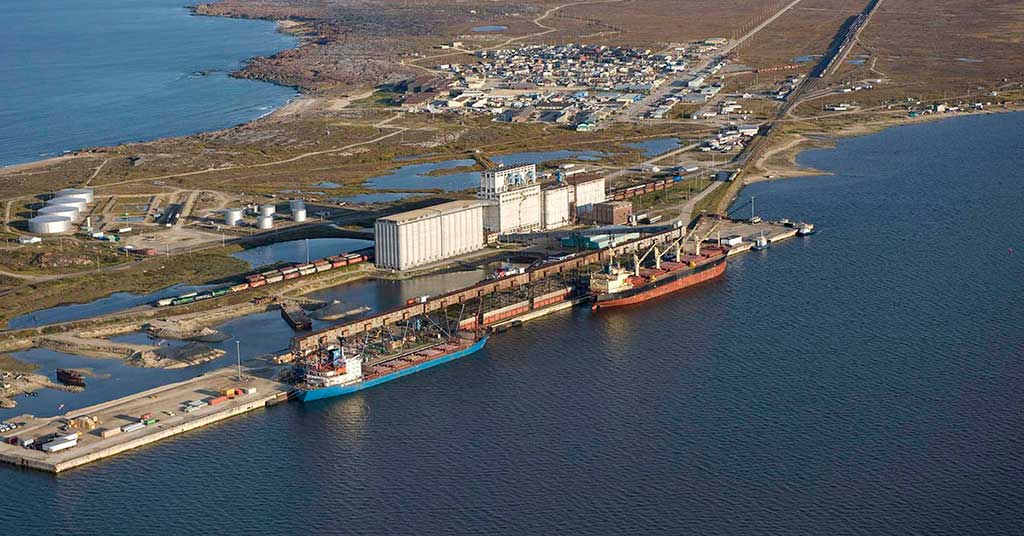
Port of Churchill is the Prairies’ only answer to direct tidewater access
Manitoba went to Mark Carney’s recent Canada Investment Summit in Toronto to sell a $70 to $80 billion expansion of the Port of Churchill, paired with talk of an “associate membership” arrangement between Canada and the European Union.
The sudden attention on Hudson Bay signals something deeper: a recognition that Canada’s future prosperity depends on claiming its northern geography and building sovereign export capacity that is not hostage to provincial politics or foreign bottlenecks.
Associate membership is a slogan, while a winter-capable shipping route through Hudson Bay is a plan.
The Port of Churchill is Canada’s only deepwater Arctic port connected to the North American rail network and the Prairies’ only tidewater access. That strategic advantage is not new. What is new is the ambition to turn Churchill into a much larger northern trade gateway.
Prairie exporters have long relied on rail corridors and marine terminals thousands of kilometres away, often through jurisdictions reluctant to support western energy or infrastructure. Quebec’s persistent refusal to allow pipelines from Alberta and Saskatchewan has hardened Prairie sentiment: if the West cannot get its goods to tidewater through the St. Lawrence, then it must build its own path to the sea.
This is not about regional spite. It is about reducing economic dependence on transportation routes that Prairie producers do not control.
Two groups have emerged as leaders in the push to turn Hudson Bay into a major trade corridor. Arctic Gateway Group (AGG), owned by 29 First Nations and 12 northern communities, operates the Hudson Bay Railway and the Port of Churchill. Its work has restored a critical lifeline and demonstrated that northern infrastructure can be both resilient and community-driven.
AGG’s own math for a heavier railway and usable port: $2 to $3 billion, far short of the much larger vision behind “Churchill Plus.” NeeStaNan, with northern Manitoba’s Fox Lake Cree Nation, is studying a multifunctional port at Port Nelson, where Canada began building a Hudson Bay port and railway before abandoning the project in favour of Churchill.
NeeStaNan’s regional MOU partner, Northern Prince LNG, proposes liquefying natural gas on the Prairies, moving it by rail to Port Nelson and loading it on LNG carriers destined for Europe.
One port and rail corridor is operating and underfunded, while the other offers an alternative export route still under study. Canada needs both.
AGG’s line turns north at Amery for Churchill. NeeStaNan’s proposed 150-kilometre rail spur would run from the Gillam area to the mouth of the Nelson River, creating another route to Hudson Bay. Both routes connect to the Prairies through The Pas, Manitoba, and the CN rail network.
Critics often argue that shipping from Hudson Bay is less economical than exporting through Montreal or Atlantic Canada. The economics tell a different story. A Panamax grain vessel can carry roughly the equivalent of four modern 147-car grain trains at a dramatically lower cost per tonne.
Hudson Bay shortens the sea leg to Europe relative to the Gulf and trims the mountain grind to Vancouver. The honest cost question is ice season, draft and rail weight, not whether a Prairie grain elevator should keep feeding Ontario’s Thunder Bay.
The build that lasts is not a single commodity dock.
It is a multi-use corridor: rail, transmission and pipelines for oil and gas in one surveyed right-of-way, with one review and one permit for what sits inside the fence. That is how you stop a decade of serial hearings from killing the pipelines after the first rail spike. Hydrocarbons and electricity pay for the grade, while agriculture, mining and forestry commodities follow when the elevator can book a boat.
Those projects require skilled labour. Fly-in camps inflate groceries and empty before the next census. Manitoba and Saskatchewan should do what the Dominion Lands Act did in 1872: make free Crown land available to families at corridor hubs and terminal towns so carpenters and signal maintainers can own a lot instead of a bunk. Housing supply is workforce policy, and without it, “nation-building” is a hotel invoice.
But none of this creates genuine export independence if Hudson Bay remains only a seasonal gateway. Canada is expanding its icebreaking capacity under the National Shipbuilding Strategy, removing one of the major obstacles to extending northern shipping beyond the traditional season.
Build the corridors and the cargo mix widens to manufactured goods, containerized freight and northern resupply. The Prairies will finally have a direct outlet to global markets that does not depend on the political disposition of other provinces or the congestion of southern ports.
Reclaiming the North is not nostalgia.
Canada does not lack access to world markets because it lacks geography. It lacks access because it has failed to build the infrastructure needed to use the geography it already has.
Canada Strong is a railway that won’t wash out and a port that won’t wait for Ottawa’s mood. Economic sovereignty is economic security and a Prairie door on Hudson Bay, open more than one season, owned by the people who live on the line.
Dr. Joseph Fournier is a senior fellow at the Frontier Centre for Public Policy. An expert in economic analysis and structural policy, his research focuses on productivity, regional migration and sustainable economic renewal in Canada.
Explore more on Infrastructure, Trade, Arctic
The views, opinions, and positions expressed by our columnists and contributors are solely their own and do not necessarily reflect those of our publication.
Troy Media empowers Canadian community news outlets by providing independent, insightful analysis and commentary. Our mission is to support local media in helping Canadians stay informed and engaged by delivering reliable content that strengthens community connections and deepens understanding across the country.

