
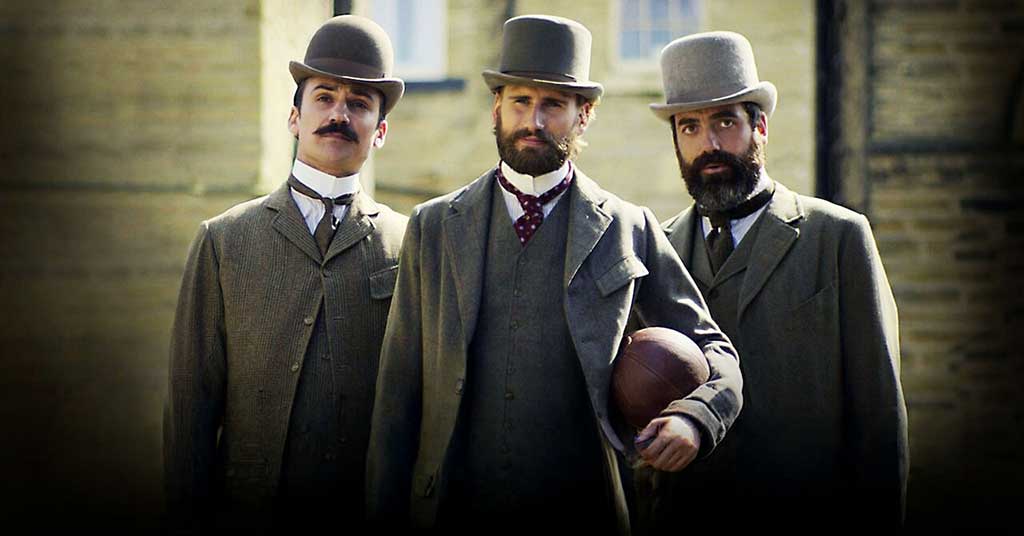
The real story behind the birth of professional football was compelling enough without rewriting so much of its history
How did you spend your civic holiday in Canada? I finally got around to seeing a Netflix series on the origins of association football in England. After binge-watching the episodes, my evaluation was almost exactly what I assumed it would be. While the series was well made and had some enjoyable moments, there were far too many historical inaccuracies for my taste.
That’s par for the course when it comes to the entertainment industry’s retelling of moments in history. No one is suggesting every detail can be properly covered on film, TV and radio, least of all me. Alas, the temptation of using artistic licence as opposed to real events seems to be too great for Hollywood to resist.
This was certainly the case with The English Game.
The six-part original series that covered British history, sport and drama—with a little bit of light humour mixed in—was released by Netflix on March 20, 2020. That was nine days after the World Health Organization declared COVID-19 to be a global pandemic. As many of us hunkered down in our homes during what seemed like an uncertain future, this opened the door for Netflix subscribers to watch the entire series.
Why wasn’t I among them? Our family didn’t subscribe to Netflix at that point. By the time we finally joined several years later, there were other movies, sporting events and TV series to watch. The civic holiday, also known as Simcoe Day in Toronto, seemed like the best time to watch it from start to finish.
The English Game focuses on football’s transformation from an amateur game played by upper-class society to a professional sport that included teams from working-class communities. Several historical figures from the early days of English football are portrayed. Fergus Suter and Jimmy Love, two legendary Scottish players who were among the first professional footballers in England, are prominently featured. Arthur Kinnaird, one of England’s first football stars who became president of The Football Association, is one of the main characters. Other individuals included Tommy Marshall, Alfred Lyttelton, A.N. “Monkey” Hornby, Francis Marindin and Jack Hunter.
The starting point is the 1879 FA Cup quarter-final between the wealthy Old Etonians and the mill workers of Darwen FC. The former took a 5-1 lead at half-time, but the latter tied things up in the second half thanks to their new acquisitions, Suter and Love. The Old Etonians, who were also the FA Board members, refused to play extra time. They called for a replay, which they won handily by shadowing Darwen’s two star players.
Many other stories and subplots emerged with each episode.
Suter would be approached by Blackburn FC’s manager, John Cartwright, for instance, to join his team with the guarantee of more money than what Darwen’s owner James Walsh had secretly paid him. He eventually agreed to this arrangement to get his mother and two sisters away from his father, an alcoholic with a violent temper. Love would find love with Doris Platt, and Suter would do the same with Martha Almond, who, in an interesting twist, had a child out of wedlock with Cartwright.
Meanwhile, the Old Etonians were furious that working-class towns were moving in on their game. Kinnaird experienced a change of heart and recognized that football was for everyone. He grew closer to his wife, Alma, after the loss of her pregnancy, butted heads with his father, Lord Kinnaird and gained a mutual respect with Suter when Blackburn’s FA Cup semi-final appearance was in jeopardy. The final between the Old Etonians and Blackburn would lead to the moment where Suter’s heroics enabled the Lancashire working-class community to hold the Cup and amateur players realized their moment in the sun was over.
The English Game certainly had its good moments. Julian Fellowes, an award-winning director and producer who created the series, devised some intriguing storylines and plot twists and filmed everything in the beautiful county of Yorkshire.
Alas, the number of historical inaccuracies was far too significant to ignore.
Darwen and the Old Etonians played three times in 1879, including two FA Cup replays before the latter finally won. There were two Blackburn-based teams in those days, Blackburn Olympic and Blackburn Rovers, which were combined for the Netflix series. Olympic would become the first working-class team to win the FA Cup in 1883, the year after Suter’s team, Blackburn Rovers, lost the final to the Old Etonians. Suter and Rovers would win three consecutive FA Cups between 1884 and 1886.
Hence, The English Game’s suggestion that Suter’s journey to Cup glory occurred in one season was incorrect, too.
Some details about Suter and Love are also wrong. Love joined Darwen after Suter. He never played permanently for a Blackburn team and didn’t injure his leg like the series suggested, but left football to join the Royal Marines. As for Kinnaird and his wife, they didn’t experience the miscarriage that was detailed in every episode.
Is The English Game worth watching as a form of pure entertainment? Yes.
Will the litany of historical inaccuracies ruin the enjoyment for viewers? Maybe not for everyone, but certainly in my case. The ball is round, as German coach Sepp Herberger once said, but the facts aren’t perfectly square.
Michael Taube is a political commentator, Troy Media syndicated columnist and former speechwriter for Prime Minister Stephen Harper. He holds a master’s degree in comparative politics from the London School of Economics, lending academic rigour to his political insights.
Explore more on History, Netflix
The views, opinions, and positions expressed by our columnists and contributors are solely their own and do not necessarily reflect those of our publication.
Troy Media empowers Canadian community news outlets by providing independent, insightful analysis and commentary. Our mission is to support local media in helping Canadians stay informed and engaged by delivering reliable content that strengthens community connections and deepens understanding across the country.

