
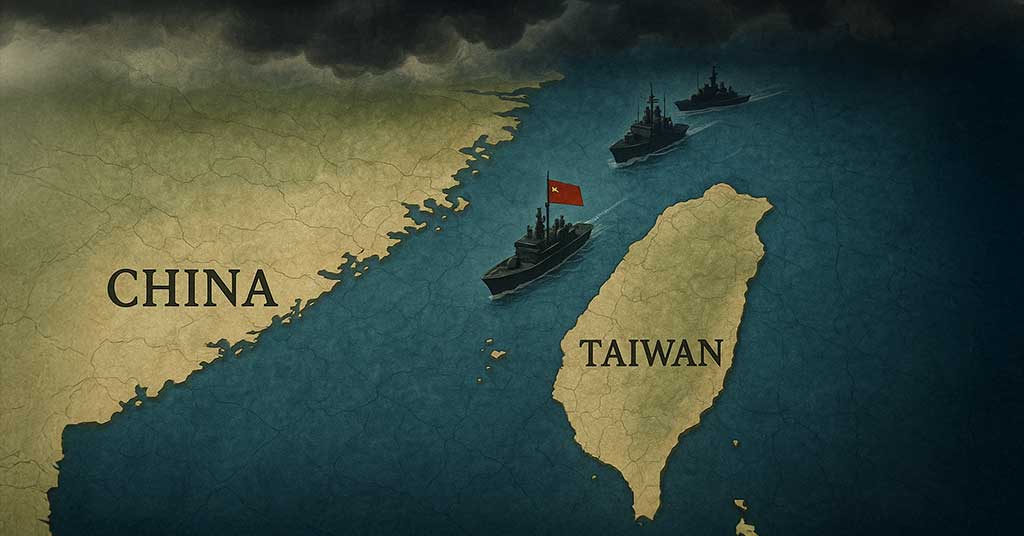
The U.S. has no obligation to act, allies won’t step in alone, and Taiwan isn’t ready to fight on its own

The future of Taiwan is much in the news these days. Will China invade? If so, what will the Americans do? And what implications are there for the rest of the world?
Things have changed since I wrote about this several years ago, so another look is in order. Let’s begin with a brief historical recap.
Taiwan is an island off the southern coast of China that came into China’s political orbit during the 17th century and was formally annexed in 1683. The overwhelming bulk of the current population is ethnically Han Chinese, albeit with a small Indigenous component of about two per cent.
After losing the First Sino-Japanese War, China ceded Taiwan to Japan in 1895, thus initiating 50 years of Japanese rule. This ended with Japan’s Second World War capitulation.
Meanwhile, China was in the throes of a civil war between Mao Zedong’s communists and Chiang Kai-shek’s nationalists. And following his 1949 defeat, Chiang evacuated to Taiwan, bringing along approximately two million soldiers and followers. Once there, he led a government-in-exile that was widely recognized as the legitimate government of China until 1971.
Although not on the same brutality scale as Mao, Chiang was still a nasty piece of work. His troops “behaved like an occupying force, seizing land and plundering the island.” The infamous “228 massacres” killed approximately 28,000 people, and the island was ruled under martial law until 1987. Since then, it’s evolved into a prosperous, high-tech democracy that’s now home to over 23 million people.
Considering Taiwan to be an integral part of its homeland, China has been clear about its intention to assert that right by whatever means necessary. And military force is an explicit option.
Hitherto, American policy has focused on what’s called “strategic ambiguity,” essentially leaving open the question as to how it would respond to a Chinese invasion. This posture has the obvious advantage of encouraging China to think twice. In fact, there are some who proclaim that America would have no option but to directly intervene.
To my mind, this thinking is best described as wishful. America has no treaty obligation to commit forces in Taiwan’s defence. And even if it did, there’s no way that any American administration—whether Republican or Democrat—is going to war with China over this. Taiwan is almost 12,000 kilometres from America’s west coast and the idea of fighting a naval battle that far from home is a daunting prospect.
What’s more, China would be a formidable foe. Not only is it a nuclear power with a population several times that of America, but it has also been furiously expanding its navy to the point where it now has more warships than the U.S. America’s navy may still be superior in terms of technology and considerations like the number of aircraft carriers and submarines, but an all-out naval conflict in China’s home waters would be an extremely high-risk proposition.
There’s also speculation about other allied powers, such as Japan, South Korea and Australia, entering the fray. But you only have to look at the elaborate tap dancing around Europe’s “coalition of the willing” to realize that, absent the deployment of America’s hard power, such scenarios are a figment of the imagination.
It’s true that a Chinese amphibious invasion could be very costly. As illustrated by the Pacific battles during the Second World War, a determined defender can inflict horrendous casualties. And the current Taiwanese government has talked about doing precisely that. However, military preparation for such an eventuality has hitherto been less than stellar—planned defence spending won’t pass the three per cent of GDP threshold until next year.
And there are grounds for wondering just how vigorously the bulk of the Taiwanese population would participate in such resistance, particularly if they’re on their own. While the West may be heavily invested in the ethos of multiculturalism, it isn’t a universal value. To quote Chinese President Xi Jinping: “Blood is thicker than water, and the people on both sides of the Strait are connected by blood.”
The forcible subjugation of Taiwan would obviously be a tragedy for its people, a blow to democracy, and an upset to the international order. Beyond that, though, there’d be a seriously negative tangible effect.
Taiwan currently manufactures some 90 per cent of the world’s most advanced semiconductors, the indispensable electronics for everything from smartphones to sophisticated military and medical applications. The idea of Beijing’s dictatorship having the upper hand in such an arena should give pause to even the most complacent.
When Franklin D. Roosevelt declared America to be the “Arsenal of Democracy” in the early days of the Second World War, it was within his power to make that happen. With its vast, self-contained industrial capacity and technological know-how, the U.S. had an independent room to manoeuvre, surpassing that of any adversary.
We should want the West to acquire that capacity again. In practical terms, this means the U.S. doing much of the heavy lifting—and thus having the most influence. We may not like it, but that’s reality.
On the other hand, we could just carry on as we are and hope for the best.
Hope, as they say, is not a strategy.
Troy Media columnist Pat Murphy casts a history buff’s eye at the goings-on in our world. Never cynical – well, perhaps a little bit.
Explore more on Taiwan, China, United States, International relations, War/Conflict, Democracy
The views, opinions, and positions expressed by our columnists and contributors are solely their own and do not necessarily reflect those of our publication.
Troy Media empowers Canadian community news outlets by providing independent, insightful analysis and commentary. Our mission is to support local media in helping Canadians stay informed and engaged by delivering reliable content that strengthens community connections and deepens understanding across the country.

